Archive for the ‘Nature as Art’ Category

Turkey Creek Nature Preserve Enhanced

November 8th, 2008

turkey_creek6b.jpg
Glynn Wilson
An ecoscape enhances the entrance to Turkey Creek

by Glynn Wilson

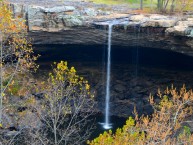
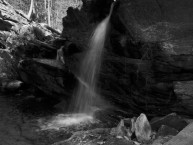
Turkey Creek Falls, a power spot in nature not far from here just off state highway 79 and the old Narrows Road, is looking more like a park than ever thanks to local volunteers and the Southern Environmental Center at Birmingham-Southern College.

They recently built an “ecoscape,” a garden of native plants, at the entrance to the 466-acre Turkey Creek Nature Preserve, home of the rare vermilion, watercress and rush darters, along with the flattened musk turtle, also on the federal endangered species list.

The spot has long been a summer swimming hole for the area’s youth. Even my 81-year-old mother remembers going there to cool off and have fun as a child during the Great Depression.

It was a popular spot for skipping school and drinking beer when I was in high school, but the area has a history of being trashed by rednecks who have somehow escaped the education they need to understand how to protect nature as they enjoy it.

turkey_creek8b.jpg
Glynn Wilson
Deputies patrol for vandals and litter bugs…

Jefferson County sheriff’s deputies now patrol the area, making it harder to sneak in a little spleef. The city of Pinson and Jefferson County erected a gate to guard the entrance, which is closed at night to keep out “vandals.” Birmingham-Southern is also renovating a house nearby for a full-time caretaker and director of educational programs.

Some years back, the Freshwater Land Trust bought 141 acres with $1.4 million from the Jefferson County Greenways program and combined it with the 325 acres owned by the county, where local citizens fought off an attempt to build a prison on the site. The Forever Wild fund, Alabama’s land preservation program funded in part from auto tags, later purchased the property for $2.2 million.

A half a million dollars of that was set aside for an environmental center, which will be used for research and to teach high school and college students about the area’s biology.

White tailed deer, river otters, and other wildlife grace the spot, and even turkeys have been spotted since authorities limited access to the site.

It’s another shining example of nature not far from the bustle of the city, where a person can go to slow things down and tap into their natural biophilia and sooth the soul from the stresses of modern life.

Let’s just hope they don’t patrol it to death and take all the fun out of it. Nature and humans need a certain amount of freedom to go along with all these social controls.

turkey_creek7b.jpg
Glynn Wilson
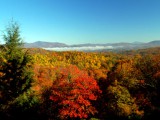
An early autumn view of the Turkey Creek Falls

A Fall Lake Scene in St. Clair County

November 5th, 2008

fall_lake2b.jpg
Glynn Wilson

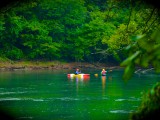
We were riding around in the country on election day in the Chevy van looking for a fall color feature photo — and some light at the end of the political tunnel — when we ran across this small, suburban lake with a few Canadian geese feeding on the bank in St. Clair County, Alabama. I must say, things are looking up today : )

Ah, A Painted Lady on a Sunday Afternoon…

October 26th, 2008


monarch_butterfly102608b.jpg
Glynn Wilson
I thought I had missed the monarch butterfly migration coming through central Alabama this year. The sun on Sunday afternoon brought a few more out and through this area, but they were shy on the butterfly bush next door. This happens to be a painted lady [vanessa cardui], and has some interesting blue-green coloring and a thick body. The wing pattern is definitely not that of a monarch [danaus plexippus].This species deserves its alternate name, “Cosmopolite,” according to the Nature field guide.

Despite its inability to overwinter in any stage above a certain undetermined latitude, the Painted Lady is perhaps the most widespread butterfly in the world, found throughout Africa, Europe, Asia, and many islands, as well as in North America. Most of North America is devoid of Painted Ladies between the first heavy frosts and the onset of spring, although they occur year-round in the Sonoran deserts and perhaps other warm regions.

In February and March, Painted Ladies begin infiltrating the North and East from the Southwest, and by late spring, they have recolonized the continent. The number of immigrants fluctuates greatly from one year to the next. Several mechanisms have been proposed to explain the variance: cycles of parasite attack, host plant defoliation, and superabundance of nectar following heavy winter rains.

Unlike the Monarch’s annual round-trip outings, the movements of the Painted Lady are essentially one-way.

Interesting timing running into this one, considering my long fascination with the ghosts of other painted ladies from times gone by. There was Ms. Dupre in New Orleans, etc…

We’ll be breaking the camera out more after the election, and budget willing, taking a fall trip soon…

It’s Blueberry Picking Time in Blount County…

August 11th, 2008

The blueberries are ripe in Blount County, Alabama, and you can pick your own for $10 a bucket at many farms, including Lasseter Orchards just south of Locust Fork.

For more information and to find a U-Pick farm, follow the yellow brick road…

PickYourOwn.org