by Glynn Wilson
A majority of Americans, 53 percent, say middle-income earners would be better off in four years if President Barack Obama is re-elected than if Republican challenger Mitt Romney were to win, according to the latest Gallup poll on the subject.
A majority of Americans also say lower-income Americans would be better off under an Obama presidency, while upper-income Americans might do better under Romney.
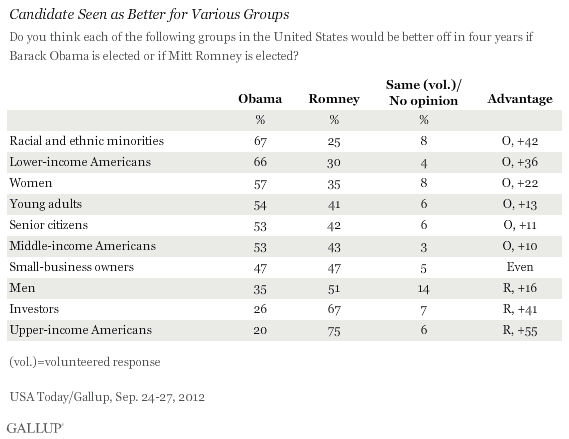
Other groups that Americans believe stand to do well under Obama are racial and ethnic minorities, women, young adults and senior citizens. Anywhere from 53 percent to 67 percent of Americans name Obama as better for these groups, compared with fewer than half picking Romney.
In addition to upper-income Americans, respondents say investors and men would fare better under a Romney presidency. Americans are evenly divided as to which of the two candidates would be better for small-business owners.
Responses Show Predictable Partisan Patterns
As would be expected, these views are highly partisan — with the vast majority of Republicans and Democrats naming their own party’s candidate as better for most groups. The only exceptions are that two-thirds of Democrats believe upper-income Americans would be better off under Romney — indicating that they don’t consider this a positive credential. Also, Democrats are evenly divided between naming Obama (46 percent) and Romney (48 percent) as better for investors.
The views of Independent voters closely match those of the public at large, giving President Obama an advantage given their role as swing voters in what could be a close election.
Bottom Line
“Americans overwhelmingly believe a continuation of the Obama presidency would be more helpful to racial and ethnic minorities, lower-income Americans and women than would a Romney presidency,” Gallup concludes in its analysis of the public opinion survey data. “On the other hand, they perceive that upper-income Americans and investors would be better off if Romney wins. These images of the two candidates generally fit the traditional profile of the Democratic and Republican parties. Also, the view that a Romney presidency would disproportionately favor the rich and investors has been a persistent theme in the Obama campaign’s focus on Romney, underscoring concerns highlighted earlier by the Occupy Wall Street movement.”
Still, it is not clear whether these strong special-interest-oriented associations are more helpful or harmful to either candidate, according to Gallup.
“For example, some may consider Romney’s potential aid to investors as undesirable, while others could see it as a positive — believing that what is good for investors is in turn good for the overall economy,” Gallup says. “Similarly, the view that Obama would help lower-income Americans is likely considered positive by many, but could be interpreted as more negative by those who are leery of increased government involvement in redistribution of income.”
Small business ranks as one of the most well-respected institutions in the U.S. according to recent Gallup polling, and thus it’s notable that Obama and Romney are tied in perceptions of whose presidency would most benefit small-business owners.
Perhaps the most important of these groups for the candidates is “middle-income” Americans, as this represents the broad core of the electorate, Gallup concludes. “The fact that Obama has a 10-percentage-point edge over Romney in perceptions of the candidate who would be better for this group may help explain his current advantage in registered voters’ preferences for president in the Gallup Daily tracking.”
Survey Methods
Results for this USA Today/Gallup poll are based on telephone interviews conducted Sept. 24-27, 2012, with a random sample of 1,446 adults, aged 18 and older, living in all 50 U.S. states and the District of Columbia. For results based on the total sample of national adults, one can say with 95 percent confidence that the maximum margin of sampling error is plus or minus 3 percentage points.
© 2012, Glynn Wilson. All rights reserved.