Supreme Court Loss Fails to Stop Riley’s Corrupt Plan
Glynn Wilson
by Glynn Wilson and Roger Shuler
 |
| Glynn Wilson |
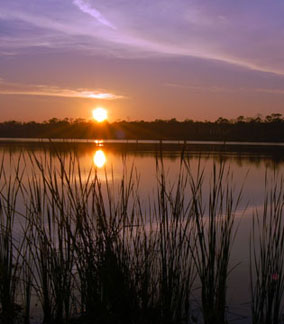
| A sunrise view in Gulf State Park over Lake Shelby toward the beach, a view that would be directly obscured by Bob Riley’s planned 13 story high rise spa resort… |
Like the neo-cons who concocted a think tank plan for the development of Iraq well before 9/11, which gave the Bush administration the pretext it needed to start a war, Alabama Governor Bob Riley had plans to raid Gulf State Park for private development well before Hurricane Ivan the Terrible came ashore in September 2004, according to court documents.
The Alabama Supreme Court recently upheld a circuit court ruling striking down the plan for an upscale private hotel and spa on the stretch of public beach where the Gulf State Park lodge and convention center was located before Ivan blew ashore and obliterated it. It sits on the widest and most ecologically important piece of land on the short and thin spit of a peninsula that makes up the Alabama Gulf Coast. Ceded to Alabama as worthless swampland when the Spanish controlled Florida, it only stretches 32 miles from the tip of Ft. Morgan on the West to the Flora-Bama Lounge on the Alabama-Florida line.
Gulf State Park is no doubt the “most treasured piece of public land in Alabama,” said Charley Grimsley, who sued to stop the development.
“Sadly,” he said, “when Bob Riley first became governor of Alabama, he immediately embarked upon an elaborate plan to take a prime portion of the beach away from the people to build a four-star Ritz-Carlton-style hotel, complete with a luxurious spa fit for a king.”
In the Associated Press story about the court decision, the wire service includes this inaccurate background paragraph:
After the old lodge was wrecked beyond repair, Gov. Bob Riley’s administration came up with a plan to build an upscale park hotel in a partnership between Auburn University and Atlanta-based West Paces Hotel Group.
Court documents show Riley had grand plans for the property well before Ivan.
 |
| Glynn Wilson |
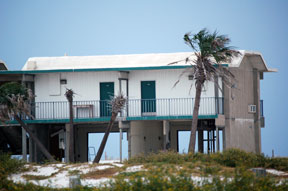
| A view of the old Gulf State Park resort, after Ivan blew right through the old construction. That ain’t no parking space underneath… |
In fact, on the very day he was sworn in as commissioner, Riley dispatched his choice to head the Department of Conservation and Natural Resources, Barnet Lawley, to meet with the West Paces Hotels Group, a company with ties to an Arabian princess in the oil business who has strong ties to the Bush family herself through the bin Laden family.
According to sworn depositions in the case you can view and read for yourself here and here, furthermore, the meeting was set up by none other than Susan Hubbard, the wife of Rep. Mike Hubbard (R-Auburn), at the Ritz Carlton in Atlanta. She was an employee of Auburn University and made the introductions through Horst Schulze, the CEO. The deal was introduced to the new president, Ed Richardson, within weeks of him taking over the university.
In any other state with a fully functioning watchdog press, this deal would have raised serious eyebrows about conflicts of interest. But not in Alabama, where the corporate Newhouse news chain has a virtual monopoly on the news by virtue of it’s ownership of the three largest newspapers in the state in Mobile, Birmingham and Huntsville, as well as several TV news stations.
Charley Grimsley, the primary plaintiff in the case who sued to stop the development, was commissioner of conservation under Jim Folsom Jr. when he served as governor in the early 1990s. When asked how the case got as far as it did with so little opposition, he blamed the media in Alabama.
“Because there is a void of accountability in the Alabama media, Bob Riley is absolutely a media creation of absolute power,” he said. “There’s not been any scrutiny on him or his son or daughter. Even if he was honest as the day is long the day he took the oath of office, he’s not today, in large measure because the Alabama media have given him a free ride. They have not been the watchdogs and the eyes and the ears of the public as they should have been.”
He further blamed the environmental community in Alabama for not recognizing the importance of the state park land.
“The environmentalists have got to wake up and realize that if you get this mega-four-star hotel, the next step’s going to be to put an interstate right down through the park to get those high-end clientele down there,” he said.
No doubt somebody with close ties to Riley would have been ready to make a bunch of money off of that deal, he said, like Fob James’s sons did on the toll bridge to Orange Beach. That was another sweetheart deal virtually ignored by the Alabama press.
David Bronner, the overseer of the State Retirement System, who filed a friend of the court brief on Riley’s side in the case, has had his eye on the state park and wildlife refuge for private development for years. In 1992, he tried to get access to the land to build a 36-hole Robert Trent Jones golf course and take out a lot of the wildlife refuge, home to a host of interesting and valuable species, and acres of wetlands, land that was home to the endangered red-cockaded woodpecker and the endangered beach mouse, critical to dune habitat.
Backed up by opposition from the local press in Baldwin County and the U.S. Fish and Wildlife Service, the Corps of Engineers killed that project by denying the permit to build bridges in the wetlands for the new golf course.
While the Alabama Supreme Court may have stopped this smelly mega-development deal for now, Riley is already meeting with some of the parties in the case and planning to try and get the state legislature to re-write the law to allow the development. Will you read anything critical about this deal in a single Alabama newspaper? We doubt it.
The main legal argument that convinced a majority of the Alabama Supreme Court to vote against the plan was the State Parks Concession Act, which includes a very explicit limit of 12 years for leases. Riley wanted to lease the land to Auburn University for 70 years, which would have then turned around and farmed out the management of the hotel and resort to the private company owned largely by a Bush-connected Arabian princess.
Opponents say that would have opened up the entire park for private development, since the land would effectively no longer be a state park under that arrangement. The State Employees Association and the Alabama Education Association also opposed the plan, on the grounds that no state employees would get jobs there. Auburn employees would have been trained working at the new resort, but most of the jobs would have gone to employees of the private company.
At first glance, the Supreme Court ruling appeared to be a victory for those who want to protect Gulf State Park from private enterprise. But a closer look shows that the Republican-dominated court brought the Riley administration to the edge of victory.
The trial court in Montgomery ruled against the Riley plan on five grounds, saying it violated three state laws and two provisions of the Alabama Constitution. But the Alabama Supreme Court overruled the trial court on four of the five grounds.
The high court found that the Riley plan did violate the State Park Concession Act because it involves a lease for a term greater than six or 12 years.
But the “Exxon Eight,” as some people call the Alabama Supreme Court for its decision reducing the Exxon judgment by hundreds of millions of dollars, left open a little loophole for Riley and his cronies to crawl through. If only they could get the law changed, they might have a chance.
While the trial court said the Riley plan did not comply with the competitive bid provisions of the State Land Sales Act, the Supreme Court disagreed and said Riley’s plan didn’t have to.
While the trial court said the Riley plan did not consider the per-capita income and average family income of Alabamians, as provided by the Gulf State Park Improvement Act, the Supreme Court disagreed again. The high court also ruled the Riley plan didn’t Violate Section 93 of the Alabama Constitution, by creating a state interest in private enterprise or by engaging in works of internal improvements or the lending of money or credit without specific constitutional authority.
It also disagreed with the trial court in saying the Riley plan didn’t have to comply with Section 213.32 of the state Constitution, which requires that any facility constructed on property at Gulf State Park be operated exclusively by employees of the Department of Conservation and Natural Resources.
So the only thing standing between the Riley administration and the luxury hotel is the State Park Concession Act. If the state legislature changes the act to allow a 70-year lease, the hotel project could be a go.
Before the Supreme Court ruling, the Riley plan had to clear five legal hurdles. Now it only has to clear one, but in the legislative branch.
Riley has said he will try to get the legislature to change the law to remove those legal restrictions, and sources say he is already holding meetings with certain interested parties to try to get the deal through before his second and final term as governor ends in January 2011.
Birmingham attorney Bill Baxley, the former lieutenant governor who was incidentally the last Democrat targeted by the Birmingham News before Don Siegelman, represented Perdido Beach Resort, a.k.a. Gulf Beach Hotel Inc., in the case. He said a $100 million, 350-room “glitz and glitter” hotel would be out of the price range of most Alabamians and therefore no appropriate on state land designated for public access to average citizens.
In his Supreme Court filing, Baxley refers to the project as a “tax-exempt” hotel that would also “unfairly, unlawfully and unconstitutionally” drive his clients out of business, taking with them millions in annual state and local tax payments.
“The only thing that is going to stop this, to keep this battle from being waged by people like you and me for the rest of our lives, is to have a Constitutional Amendment to let the people vote once and for all to tie that beach up from private development,” Grimsley said. “Until the people draw a line in the sand down there and say ‘that’s the end of it,’ your always going to get developers coming to governors and saying, ‘Have I got a deal for you.'”
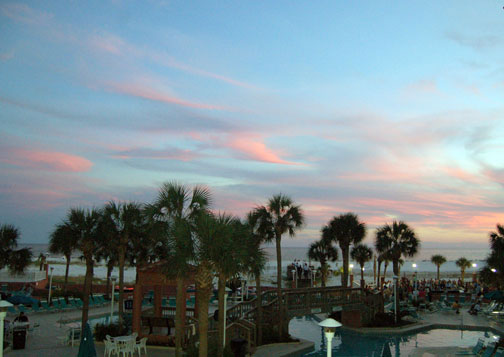
Glynn Wilson
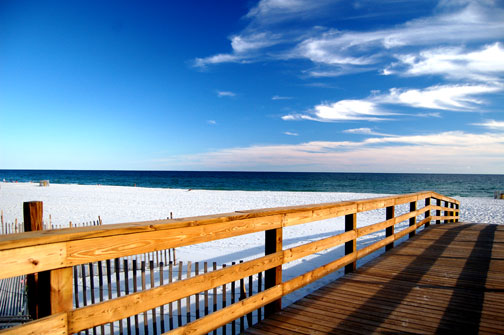
The view from behind the Perdido Beach Resort on a fine fall day a couple of years ago…
© 2009 – 2016, Glynn Wilson. All rights reserved.