by Henry B. Rosenbush and Glynn Wilson
TUSCALOOSA, Ala., Feb. 4 – Without the blues and the electric guitar and Fat Tuesday, there would be no Obama, affectionately referred to in these parts as GoBama.
I don’t know who independent filmmaker John Sayles is going to vote for today or where he plans to celebrate Mardi Gras Day.
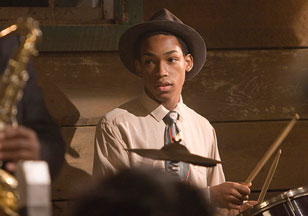 |
| Stephen Hundley of Birmingham debuts in Honeydripper |
But it may not be coincidence that he released his engaging musical comedy drama Honeydripper on the eve of Fat Tuesday AND Super Tuesday, just as Barack Obama is surging in the polls as the first black man in American history who may have a real shot at ascending to the presidency.
The scene at the historic Bama Theater, the last local palatial Depression era movie palace along with The Alabama in Birmingham, was buzzing with a record diverse crowd of 900, coming as close to filling the 1300-seat room with excitement as anyone can remember.
Filmed on location in several Alabama towns, including Greenville and Midland subbing for the fictitious town of Harmony, the first inkling you get of the place comes when itinerant guitarist Sonny Blake (the superb Gary Clark Jr.) steps off the train and says it looks like a nice town to find a place to play his guitar and sing.
But a railway station porter hints that all may not be so harmonious in Harmony.
“I’ve only been arrested once,” he says. “And the town was called Liberty.”
The subtext of simmering corruption revealed, the story drifts lazily in inoffensive fashion to the more creative side and uplifting world of rhythm and blues, although the racial component is always there, just underneath the surface. It’s 1950 Alabama, after all, well before Selma.
But aside from white Sheriff Pugh (Stacy Keach), a single scene with Mary Steenburgen and a cameo by Sayles as a whiskey delivery man, the film is inhabited primarily by rich Southern African-American characters who laid the ground work in many ways for Obama.
The film is book ended with two young black boys pretending to be musicians on the porch of a Southern shutgun house, reminiscent of most every child’s dream of one day becoming good enough at something to break the fame barrier – even if you are poor and black in America.
The story introduces a secession of colorful characters starting with Tyrone Purvis (Danny Glover) who is about to lose his roadhouse lounge, the Honeydripper, over debt to the town’s big businessmen, black and white.
In fact, our first clue that all is not well financially is a thoroughly heartrending scene as house singer Bertha Mae (Dr. Mable John) performs to an empty house, while her consort Slick (Vondie Curtis Hall) urges her on anyway. She dies a few days later, however, symbolic of the passing of the old blues style that was drawing no audience after World War II to the new music with a more powerful sound you could dance to. The scene of her funeral down an Alabama dirt road brings back memories of another time before Interstate highways, Rock ‘n’ Roll and black men running for president.
On hand for much of the comic relief is Maceo (Charles S. Dutton) as Tyrone’s friend. We meet Tyrone’s wife Delilah (Lisa Gay Hamilton) in the midst of religious uncertainty, a black preacher and gospel choir beckoning the women especially away from the darkness of the bar. His stepdaughter, newcomer Yaya DaCosta as the lovely China Doll, falls for the tall and shiny Sonny right away – over eggs and bacon, biscuits and grits.
With an excellent score of gospel, rhythm and blues, and jazz – fused with the unexpected origins of Rock ‘n’ Roll – composer Mason Darling and music supervisor Tim Bernett compile an impressive soundtrack to fit the drama.
The audience was reverent and appreciative, and the racial polemic was not lost on the older patrons, present company included, who lived through the era depicted in Honeydripper in the South. It was the same racial polemic that would have prevented the very audience assembled from mixing in public in the age of acoustic blues in the backwoods – and “Colored Only” signs across the tracks in town.
 |
| Glynn Wilson |
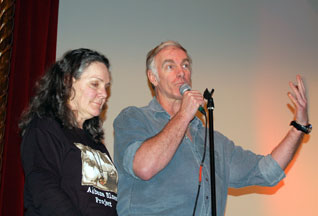
| Producer Maggie Renzi and writer/director John Sayles answer questions after the show |
Much has changed for the better since 1950 on the southern bigotry front, and Sayles the writer keeps the insipidness of prejudice encapsulated in Sheriff Pugh. Keach salvages his character from the usual stereotypical caricature by making him a rotund yokel with a fried chicken sandwich obsession, specifically from the struggling club owner’s wife. But he’s not a man who doesn’t know when it’s time to exit the scene and let people be.
With a concocted idea to save Honeydripper by attracting the regional celebrity Guitar Sam to play a one night stand, Tyrone expects to raise his family out of economic despair. But when Sam fails to show up with his guitar on the Saturday train, hospitalized for a knife fight in Memphis, a young guitar player who ends up in town looking for a chance to play is rescued from the cotton fields by day and the Harmony jail at night – and gets his opportunity to stand in for Sam and show off his homemade electric guitar.
Sonny immediately runs afoul of Pugh and is put on a work detail picking cotton. There is some smoldering potential violence involving two secondary characters whose actions will resolve an awful secret haunting Tyrone from his days as an up-and-coming piano player and his own run in with the ego of man – and a knife.
The bucolic scenery photographed by cinematographer Dick Pope reveals the rural south in pastels and browns while the production designer Toby Corbett reveals a keen eye for the verisimilitude of the period. All tech credits are superb for this low budget film. Once again all good films begin with a compelling scenario and strong acting rather than mind-numbing shootouts and car chases.
The film takes some time to get going with the abundant cast on hand. But kudos to Keb’ Mo’ as blind sage guitarist Possum who is subtly revealed as perhaps an apparition only seen by Sonny and Tyrone, showing up with sage advice at all the right times, himself playing the second guitar ever made. The devil got the first.
The introduction of Sonny’s homemade electric guitar provides a wonderful coda that segues nicely with the young boys from the opening scene, who evolve in the end in portentous ways you will have to see to judge. Some critics say the buildup took too much of the 2 hours and 2 minutes. But when it comes, the power doesn’t go off and the crowd packs in and what a new day it is for Harmony – and the Honeydripper.
The most disappointing weakness, aside from the feeling that the story could have even been stronger with more money and time, was the cheap sound system in the theater. Someone needs to write them a grant and find them a sound engineer. It was all mid-range and no bass, making some of the dialogue a tad hard to follow.
Honeydripper opens locally and in select Southern theaters February 8. It’s not only worth seeing. It should be a must see in these times, just to see how far we’ve traveled to get where we are today.
© 2008 – 2016, Glynn Wilson. All rights reserved.