State Bird of Louisiana Removed from Endangered Species List
Glynn Wilson
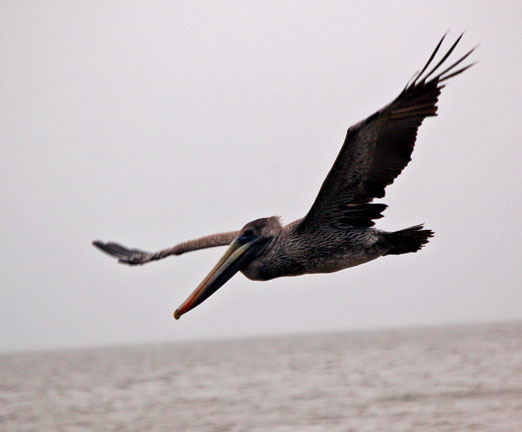
A brown pelican fishing on the Eastern Shore of Mobile Bay…
by Glynn Wilson
In the final act of a success story for federal environmental policy, the U.S. Fish and Wildlife Service has removed all populations of the brown pelican [pelecanus occidentalis] from the list of threatened and endangered species under the Endangered Species Act.
Decimated by the pesticide DDT used to kill mosquitoes that spread the deadly infectious desease malaria in the post-World War II period, the majestic bird has fully recovered due to the ban on DDT in 1972.
Secretary of the Interior Ken Salazar, Assistant Secretary for Fish and Wildlife and Parks Tom Strickland and U.S. Fish and Wildlife Service Director Sam Hamilton made the announcement in Louisiana, where the brown pelican is the state bird.
“At a time when so many species of wildlife are threatened, we once in a while have an opportunity to celebrate an amazing success story,” Salazar said. “Today is such a day. The brown pelican is back!”
The brown pelican was first declared endangered in 1970 under the Endangered Species Preservation Act, a precursor to the Endangered Species Act. Since then, thanks to a ban on DDT and efforts by states, conservation organizations, private citizens and many other partners, the bird has recovered. There are now more than 650,000 brown pelicans found across Florida and the Gulf and Pacific Coasts, as well as in the Caribbean and Latin America.
The Fish and Wildlife Service removed the brown pelican population in Alabama, Georgia, Florida, and northward along the Atlantic Coast states from the list of endangered species in 1985.
“Today’s action removes the remaining population from the list,” Salazar said.
“After being hunted for its feathers, facing devastating effects from the pesticide DDT and suffering from widespread coastal habitat loss, the pelican has made a remarkable recovery,” Strickland said at the press conference in New Orleans. “We once again see healthy flocks of pelicans in the air over our shores.”
Action was taken to protect the brown pelican, along with hawks, eagles and other birds, after former U.S. Fish and Wildlife Service biologist Rachel Carson published the book Silent Spring in the early 1960s and alerted the nation to the widespread dangers associated with the unrestricted use of chemical pesticides, which rendered the birds’ eggs so fragile they could not support young.
Hamilton praised the Gulf and Pacific Coast states for their constant efforts to restore this iconic coastal species.
“Brown pelicans could not have recovered without a strong and continuing support network of partnerships among federal and state government agencies, tribes, conservation organizations, and individual citizens,” Hamilton said. “This is truly a success story that the whole nation can celebrate.”
In the southwest, the Texas Parks and Wildlife Department, The Nature Conservancy and numerous other conservation organizations helped purchase important nesting sites and developed monitoring programs to ensure pelican rookeries were thriving.
Louisiana, long known as the “pelican state,” and the Florida Game and Fresh Water Fish Commission jointly implemented a restoration project. A total of 1,276 young pelicans were captured in Florida and released at three sites in southeastern Louisiana during the 13 years of the project.
Past efforts to protect the brown pelican actually led to the birth of the National Wildlife Refuge System more than a century ago in central Florida. German immigrant Paul Kroegel, appalled by the indiscriminate slaughter of pelicans for their feathers, approached President Theodore Roosevelt, who created the first National Wildlife Refuge at Pelican Island in 1903 and named Kroegel as the first refuge manager.
The system has grown to 550 national wildlife refuges today, many of which have played key roles in the bird’s recovery.
With removal of the brown pelican from the list of threatened and endangered species, federal agencies will no longer be required to consult with the service to ensure any action they authorize, fund, or carry out will not harm the species, according to the press release.
“However, additional federal laws, such as the Migratory Bird Treaty Act and the Lacey Act, will continue to protect the brown pelican, its nests and its eggs,” the agency, which has developed a post-delisting monitoring plan, said. The pelican could be relisted if future monitoring or other information shows it is necessary to prevent a significant risk of extinction.
The monitoring will be done in cooperation with the state resource agencies, the Commonwealth of Puerto Rico, U.S. Virgin Islands, Mexico, other federal agencies, non-governmental organizations, and individuals. The final rule removing the bird from the list of threatened and endangered species will be published in the Federal Register and will take effect 30 days after publication.
The brown pelican is unique among the world’s seven species of pelicans, in that it is the only dark pelican, and the only one that plunges from the air into the water to catch its food. It is found along ocean shores, not on inland lakes.
© 2009 – 2016, Glynn Wilson. All rights reserved.